
News

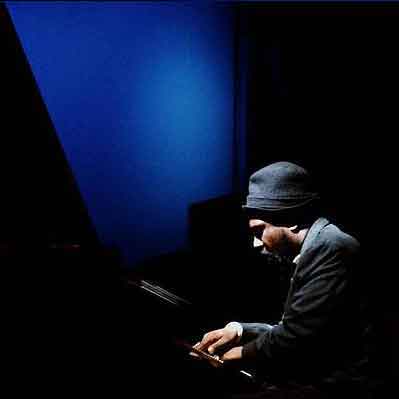
Thelonious Monk playing piano on a stage with a blue background. he is wearing a black hat.

Please join our newsletter to receive updates.

yellow wavy line

Making of the Monk Greatest Hits Playlist

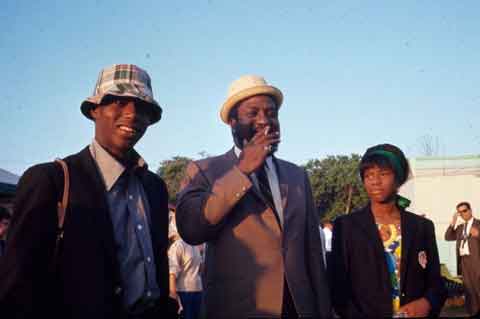
Thelonious Monk with his son T.S. Monk and his daughter Boo Boo Barbara Monk

Thelonious Monk (center) with his son, T.S. Monk (left), and his daughter "Boo Boo" Barbara Monk (right).

T.S. Monk

When it comes to explaining my ‘Thelonious Monk Greatest Hits’ playlist, my job is inescapably threefold. I wear 3 hats. 

Number one, I am his son. Number two, I had the extraordinary privilege of performing with him. And number three, I am a fan – like millions of others. 

As his son, I tend to love everything he composed because I grew up listening to all the music, starting in my mom’s tummy

Read More

Instantly, I became familiar with the music, along with my sister, “Boo Boo” Barbara Monk. The entire Monk family, both nuclear and extended, became  indoctrinated with the music. As a drummer and fellow musician, performing with Monk and so many others, playing Monk’s music was and still is an absolute joy. Why? Because every tune is swinging. And all the tunes are intellectually challenging. They are instructive, both melodically and harmonically, and they are enlightening from a spiritual standpoint.

Now from a fan’s perspective, so many of Thelonious Monk’s tunes have become what is called “standard repertoire”. Every composition is a masterpiece, and picking the one you like the most actually rotates and changes from day to day, and sometimes favorites shift moment to moment. I think this is a true conundrum for all of Monk’s fans.

Thelonious Monk is now the second most recorded composer in the history of jazz and his composition, “Round Midnight”, is the most recorded song in jazz history. He is second only to Duke Ellington, one of his mentors. The reason? Genius. Pure genius. “Monk’s Dream” is my personal favorite here. Especially his classic quartet recording on “It’s Monk’s Time” with Charlie Rouse, Frankie Dunlop, and Larry Gales.

Thelonious Monk’s piano playing is still the most unique in all of jazz. Impossible to copy. Uncompromising, and incomparable. Thelonious Monk may be the most unique instrumentalist in the history of “western music” period. So give a listen, and enjoy The Greatest.

Listen to the Playlist

Thelonious Monk playing piano and making a silly face. he is wearing a plaid golf cap.
red wavy line

Jazz and the Love of Monk

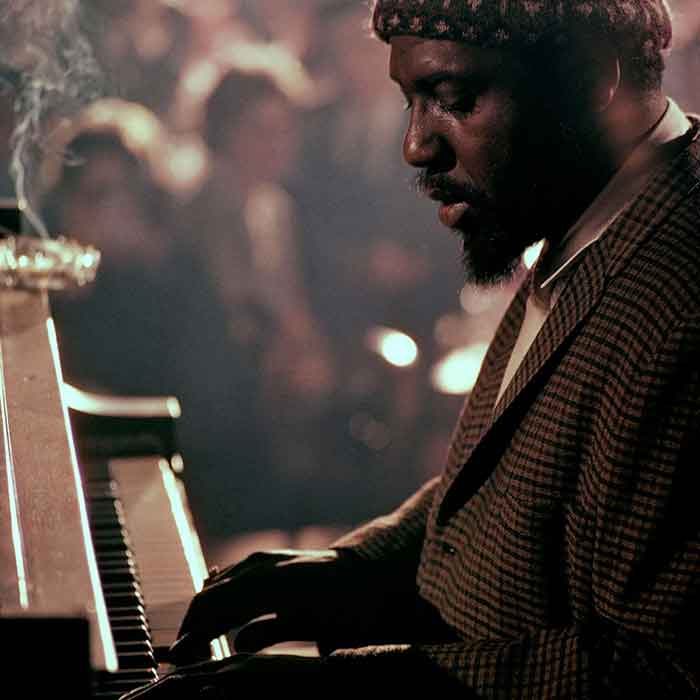
Thelonious Monk is playing piano in front of an audience. He is wearing a plaid jacket and a multicolored brimless hat.

by Greg Trout

Thelonious Monk was my first jazz love. In the past decade or so, I have found great joy in listening to a wide variety of jazz music, and I love the time I get to spend researching and exploring the records and the artists who recorded them, but it is all still thanks to the High Priest – Thelonious Monk.

As a high school student, I developed an interest in jazz with a few friends. Our ultimate goal was to have our own original punk rock band. All we knew of jazz was that it was complicated, so the idea was that if we could play jazz, we could play really cool punk music. But we ended up falling in love with jazz. Monk was the catalyst. We listened to Miles Davis’ “Four and More”. We took in early Dizzy Gillespie. A friend’s dad had a bunch of 70’s fusion records that we played repeatedly. But when we first heard Monk, we were hooked. It happened by accident, and it wasn’t even Monk playing…

Read More

In our junior year of high school, some of my friends and I decided to get together and try to jam like our heroes on the classic records of the fifties and sixties, and eventually found enough people to make a quintet of bari sax, trumpet, guitar (me), bass, and drums. We weren’t very well-versed in jazz tradition, so in deciding what to play, we all simply suggested tunes we had heard elsewhere, and sometimes we would randomly flip through a Real Book and try things that looked interesting.

One of those chosen out of visual interest from the unique score was Thelonious Monk’s classic minor blues – “Blue Monk”. I was fascinated by the simple chromatic patterns. And when the melody broke away, it almost seemed like it was deliberately avoiding traditional chord tones. Yet, it was so infectiously hummable! It was constantly stuck in my head. How had this effect been achieved? How could this tune be ignoring everything I thought I knew about what made music ‘catchy’, and still be among the catchiest tunes I’d ever heard? What music theory had gone into this? Nothing I had learned in music theory books or classes up to that point could explain Monk’s music.

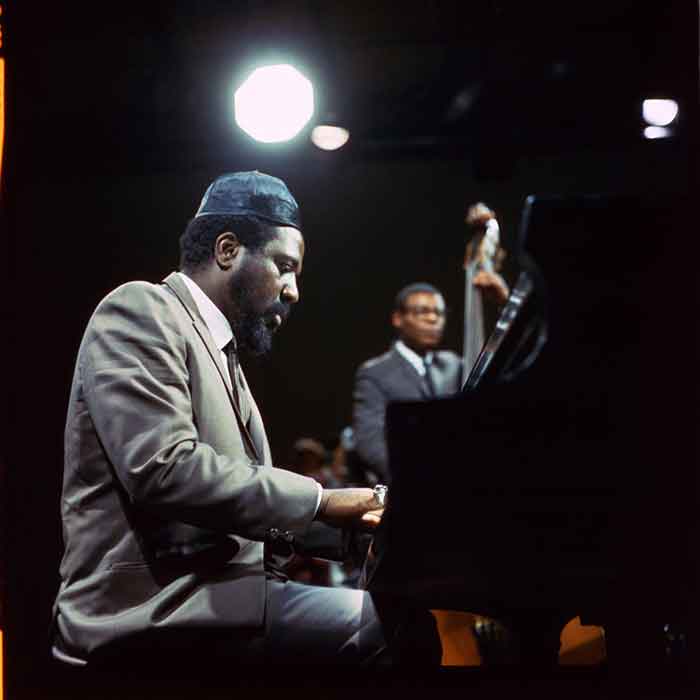
Thelonious Monk playing piano with another man playing upright bass. Thelonious is wearing a brimless hat.

Over the years, I continued absorbing more and more jazz – free jazz, especially, and the music of the spiritual jazz and black power movements in the 1970’s (I know there are many opinions about the use of those terms. I use them as colloquial descriptors, and nothing more or less).

I got heavy into the early music of Ornette Coleman, the late pseudo-religious work of John Coltrane, the high-art whimsy of Eric Dolphy, and the steam-bath aggressiveness of Albert Ayler. Pharoah Sanders’ long meditative tracks started to be a constant on my speakers.

Don Cherry’s disjointed harmonic experiments, Hannibal Marvin Peterson’s Sunrise Orchestra, the infinite palette of four decades of Sun Ra, the brilliant artist-centered work spearheaded by Charles Tolliver and Stanley Cowell as the founders and main artists on the Strata-East – Archie Shepp, The Art Ensemble of Chicago, Cecil Taylor, Lloyd McNeil, Marion Brown … it was all-encompassing, and for whatever reason, a source of unbridled joy. It taught me to be calm in the face of frustration and to seek out the order in apparent chaos.

Through these discoveries, Monk drifted from my periphery a bit. As I began to collect records, I also found great pleasure in reading about the musicians I was listening to. Several books on Charles Mingus, for example, made his music come to life for me like never before. Robin DG Kelley’s formidably-sized Monk biography was a project I took when I was supposed to be writing my master’s thesis in mathematics, but it soon became a fabulous escape. I finished the thesis, but the lasting experience of that part of my life was Kelley’s book.

One of the most poignant parts of the book for me was Monk’s reaction to the “new thing”, specifically the earliest appearances on disc and in person in New York of Ornette Coleman. Paraphrasing, Monk essentially declared that while he liked the music of Ornette and his colleagues, he felt it wasn’t really so new, and that he had been doing similar things for almost 20 years. I didn’t agree with that at all at the time, but I had a few Monk records that I enjoyed, and I listened to a few of them (especially “Criss-Cross” and “The Thelonious Monk Orchestra at Town Hall”) while reading the book. All of the magic of Monk’s music from my younger days came flooding back during those sessions, and Monk started to once again become a central focus of my collecting and listening. He was right, of course. “Blue Monk”, as well as so many of his best melodies, especially the lurching ballad “’Round Midnight”, are basically the be-bop versions of free jazz. Non-chord tones, used as a bridge to an unconventional melodic end, dominate Monk’s music, as do huge interval leaps, tone clustering, etc. All of these elements would be amplified in the free jazz movement, but with hindsight firmly in my corner, I agree with Monk. He was their originator in a small ensemble playing.

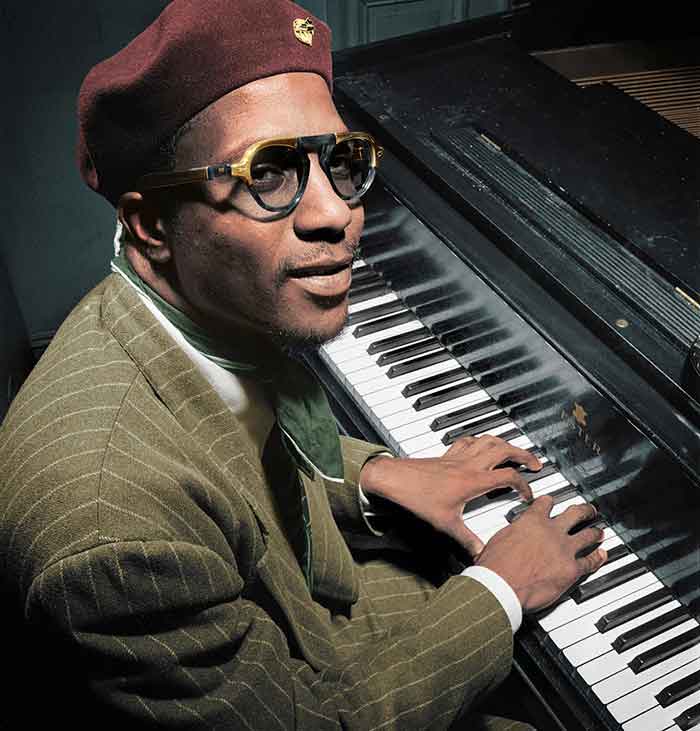
Thelonious Monk plays piano. He is wearing a maroon hat, sunglass, and an olive green suit.

Some years after my initial foray into jazz as a collector and listener, I began to seriously consider taking up the double bass, as I’d always wanted. Being a guitarist for so long, I’d played in my high school and college jazz ensembles, but never really felt satisfied with the role of my instrument. After likely getting sick of hearing me talk about it so much, my wife located a cheap used double bass for me. I began taking lessons, and thanks to my prior musical training, was able to play basic walking patterns quickly. My instructor suggested that I try my hand at live performance and mentioned that some of his students needed a bassist for an ensemble. He put me in contact with them, and at our first meeting they asked what I might like to play. Of course, I suggested “Blue Monk”.

Greg is a jazz fan and mathematician from the US Mid-Atlantic. In addition to collecting jazz vinyl, he enjoys playing the double bass and spending quality time with his wife and pug dog. Find Greg on Instagram @jazzpeasant

blue wavy line

Older News:

Monk Mantras & Positive Thinking

by Sierra Monk

View Article

Monk Mantras & Positive Thinking

by Bob Heinrichs

View Article
yellow wavy line